
What a difference a year makes. Only around 10% to 20% of cereals had been drilled by the middle of October last year, whereas we are at 80% to 90% this season. Additionally, the seedbeds have been fantastic, and even wet areas of fields are coming up the best they have in years, a much-needed boost in an economically tricky time.
Earlier drilling has meant that pre-emergence herbicides have been applied in good time, and with a bit of moisture around seem to be doing a reasonable job so far. So now efforts turn to top-up sprays where needed, along with aphicide applications.
The pre-em used will determine what will be used at the top-up timing. With early drilling, persistence is needed, and so a lot will have gone down the Flufenacet (FFT) + DFF + Aclonifen route as Aclonifen is a very persistent active. However, it can be hard on the crop, so going on early drilled crops when rainfall was low is the safest option rather than later drilled crops.
This will then likely be followed by a Cinmethylin + Pendimethalin (PDM) application. Cinmethylin is the market leader for control of blackgrass and ryegrass and has the flexibility to be applied later (up to GS30). In trials it also seems to work well if not better at the peri-emergence timing, and with good persistence it will then last well into the late autumn/winter, reducing the later flushes.
The new product Fundatis (Bixlozone + Beflubutamid) may also be an option at this stage; from what we have seen it seems to work better at the peri-emergence timing than at the pre-emergence timing. It is stronger on ryegrass than blackgrass, however, so use it cautiously as it is a new product, but it’s very welcome, especially as it’s bringing in a new mode of action to cereals.
Where grassweeds are less of a concern, most programmes will have been built around Flufenacet/DFF/Pendimethalin with, potentially, products like Tower (PDM + DFF + Chlorotoluron) or Alternator Met (FFT + DFF + Metribuzin) to bring increased broad-leaved weed control, especially on weeds such as groundsel, which seems to be becoming a tricker weed to control in the spring.
With lots of early drilling, aphids are of real concern and we are finding plenty about on emerging crops. It is important to check before applying any aphicide and to use the day degree calculations to apply once winged aphids start to reproduce and then cause an issue. We are also finding a lot of gout fly eggs on the earliest crops drilled. We had severe issues with gout fly last year in the few September crops that were drilled, so it is important to keep an eye out.
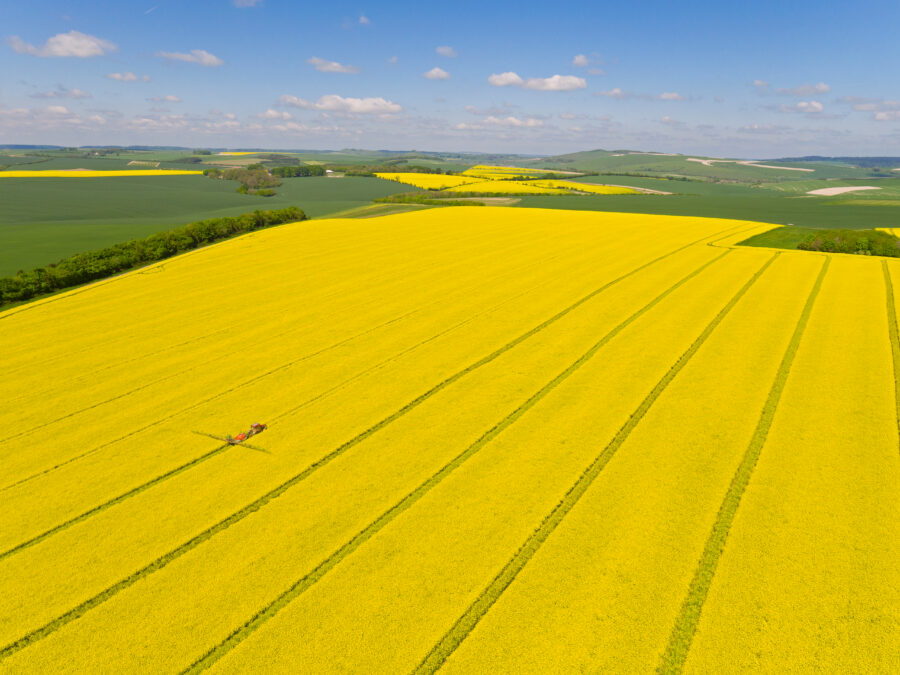
Oilseed rape has, overall, come through relatively unscathed. By being late drilled because of the drought, it has been much less affected by cabbage stem flea beetle and slug damage. With most graminicides now applied, focus turns to broad-leaved weed control. Belkar (Halauxifen-methyl + Picloram) at half rate does a good job on a lot of the common weeds, but where larger weeds are present the new product LaDiva (Aminopyralid + Halauxifen-methyl + Picloram) may be a better option.
By Brett Pointing, Agronomist and Director – Dorset.