By Brett Pointing in June’s edition of South East Farmer
For most along the south coast, the past month has seen frustratingly little rain, most of which has fallen in small quantities and has hardly even washed the last nitrogen dressing in. Only 25% of average April rainfall fell, with less than five days of rainfall above 1mm, and therefore we have levels of septoria lower than we were expecting given the early drilled wheats.
Early in the season we were seeing very high levels of septoria, and in some circumstances varieties like Bamford and Zyatt have some septoria on leaf 3. This has made T2 decisions incredibly difficult, as only a few rainfall events are needed for septoria to jump up onto the top two leaves in the way it did in 2023. With the forecast through May being fairly unsettled, cutting back significantly is difficult, but with the price of wheat as low as it is currently we are aware not to overspend.
T3 decisions will be equally difficult, as so much depends on what the weather throws at us at the end of May/early June. Where costs have been cut at T2 it might allow a more comprehensive T3 if it turns wet. Actives such as pydiflumetofen (Miravis) and fenpicoxamid (Univoq) fit the T3 slot well as both will give good septoria and fusarium protection, provided they were not used at T2.
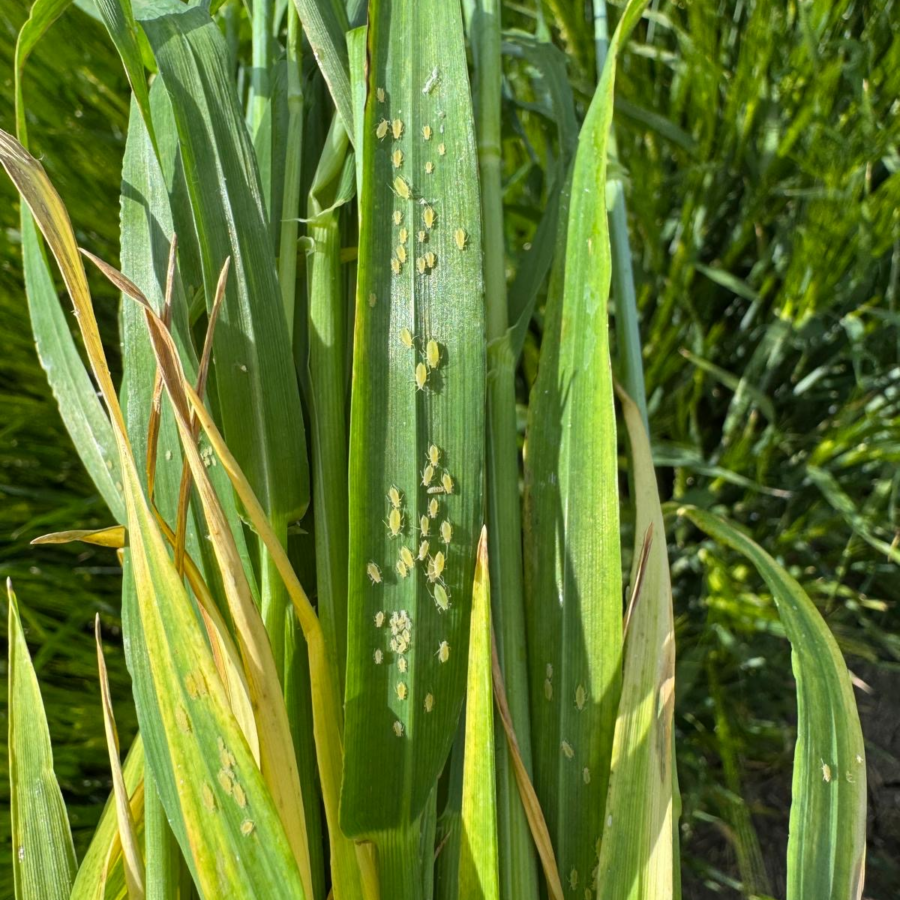
The main story of the season, though, has been aphid armageddon. Across the south, aphid numbers have been at seriously worrying levels this spring. Most autumn applications of aphicides controlled populations well, and areas of fields that wouldn’t travel are obvious to see.
However, what’s particularly worrying is the huge numbers that have been flying since March, causing spring barley yellow dwarf virus infections not seen for many years. Crops that looked great are now showing purpling and yellowing on leaf 1 and 2, which will lead to yield loss and significant specific weight reductions.
Where aphicides were applied with T1s to try to reduce numbers, control was acceptable, but quite a number survived. Most of these seem to be grain aphids (Sitobion avenae) rather than bird cherry oat aphids (Rhopalosiphum padi), which is worrying as we don’t usually see many this far south. They also have higher resistance to pyrethroids, resulting in the lower control we are seeing.
There are several factors as to why they are in such numbers this year. A very mild winter allowed a high survival rate, a hot summer last season allowed high numbers to build up before the autumn, increased hectares of cover crops allowed a green bridge (along with late termination of cover crops due to the wet January and February), no sustainable farming incentive insecticide options, which allowed numbers to build in the field, and more crops such as maize, which harbours huge numbers. When you amalgamate these, you realise why this season is so awful.
Rarely do we need to control aphids on the ear as numbers don’t tend to meet the threshold of 50% of ears infested at flowering. This year, however, may well be the year some crops will need to be treated.
There are two options, either Insyst SL (acetamiprid) or Teppeki (flonicamid). Both are effective and should control both grain and bird cherry oat aphid, but Teppeki is much kinder on beneficials so will likely be the product of choice. Neither is cheap compared to pyrethroids, but will be needed if thresholds are met as yield losses can be significant.