
by Peter Cowlrick in October’s South East Farmer
Following the long hot summer of 2026 and with a “Super El Nino” developing that will undoubtedly impact global weather, and unlike in 1976, the UK weather seems reluctant to succumb to the vagaries of autumn just yet. Apart from the weather, farming seems to be facing an unending plethora of challenges, from escalating production costs and political ambivalence to the more tangible pest and pestilence types; the latter have been testing in almost all crops this year.
Cereal crop performance in 2026 was widely impacted by the summer heatwaves, but pest damage (in particular barley yellow dwarf virus (BYDV) and wheat dwarf virus (WDV) was also a key factor in some of the poorer outcomes.
With ominous warnings from the media and keyboard ‘doomscrollers’ about the possibility of a more tempestuous and wetter autumn than normal, it’s tempting to get the cereal drills readied for action a little earlier. However, before dropping the chequered flag and joining the ‘October drilling is for losers’ club, a resumé of some of the issues arising from this time last year would be prudent.
Following another hot and dry summer in 2025, and a run of difficult autumns, cereal drilling in many areas was underway by around 20 September and on many farms completed by 5 October. At the time, with excellent seedbeds and adequate moisture for residual herbicides, this seemed appropriate – but the consequence of such widespread early crop emergence was that crops were exposed to a number of damaging pests, in particular gout fly, cereal aphids and the hitherto overlooked cereal leafhopper.
The autumn generation of gout fly adults appears in late September, laying eggs on emerged wheat and barley leaves. These eggs then hatch into larvae that burrow into the shoots, causing the classic, swollen, ‘gouty’ tillers the following spring.
In most years, winter cereals can compensate for the loss of infested tillers without significant yield impacts, but in years where such extreme heat follows, the crop’s ability to compensate is reduced, leading to greater yield impacts. A well-timed pyrethroid targeting gout fly eggs before they hatch can provide a high level of control, but almost no control after egg hatch.
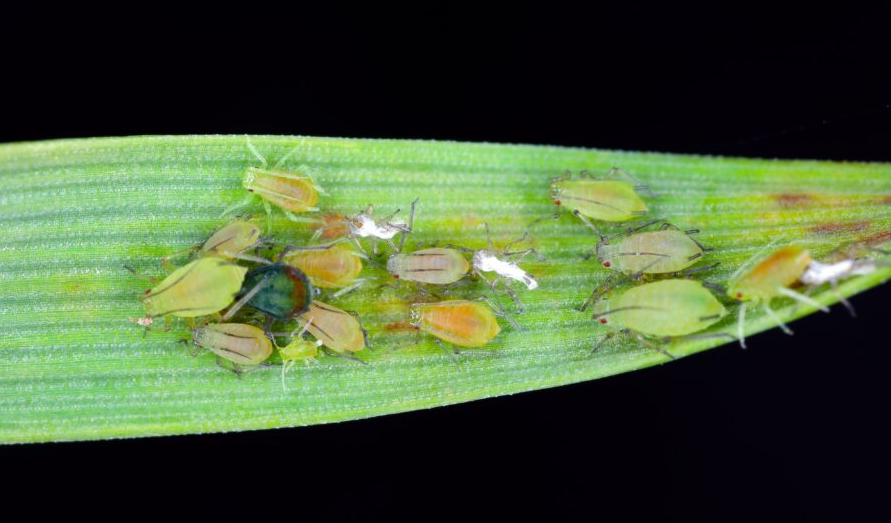
However, cereal aphids with their propensity to spread BYDV, and leafhoppers and the spread of WDV, were a more significant and widespread factor in reduced cereal yields. The main vectors of BYDV in cereals are the bird cherry (Rhopalosiphum padi) and grain (Sitobion avenae) aphids, which can both migrate into autumn-sown cereals as soon as they emerge, at which point they transmit BYDV into the plant via their feeding stylets.
Five years ago, between 5% and 20% of grain and bird cherry aphids were carrying BYDV, but last autumn the figure was nearer 35%, meaning the overall viral loading was much greater. A further complication is that around 50% of grain aphids carry the Kdr mutation that confers reduced pyrethroid control. More recently, a ‘super Kdr’ mutation has been discovered; grain aphids can migrate throughout the winter in milder coastal areas and probably did so even inland last winter due to ongoing mild weather.
Suction traps even caught grain aphids during March this year; subsequently, aphids (primarily grain) were widespread in many cereal crops by late April, with the resultant yellowed upper leaves showing by ear emergence, leading to reduced grain fill. Well-timed autumn pyrethroid sprays meant the more typical stunting symptoms associated with BYDV were generally less apparent, but yield reductions from early spring-transmitted BYDV here in the south typically ranged from 10% to 50%.
The other virus vector of note, leafhoppers (Psamotettix alienus), transmit WDV. This is a relatively new pest to the UK that is favoured by hot summers, mild autumns and early wheat and barley drilling. The leafhopper feeds on the emerging coleoptile, and in so doing transmits WDV, which results in 100% yield loss in infected plants. Virus testing of crops displaying crop yellowing/stunting this spring have shown the presence of WDV infections to be more widespread than previously thought. There is no means of effective chemical control, with delayed drilling into the second week of October or later the only reliable control measure.
Perhaps having a proportion of October drilling isn’t for losers after all, but only time will tell.